
As seen on Open Homes Australia Season 4 and Australia’s Best House Season 3
May 2026 Update:
Our service electricians are currently flat out, so we are only offering EV Chargers as part of a solar and/or battery installation. Please contact Stay Bright Electrical if you live in Brisbane North or DRC Electrical if you live in Brisbane South for a quote and installation.
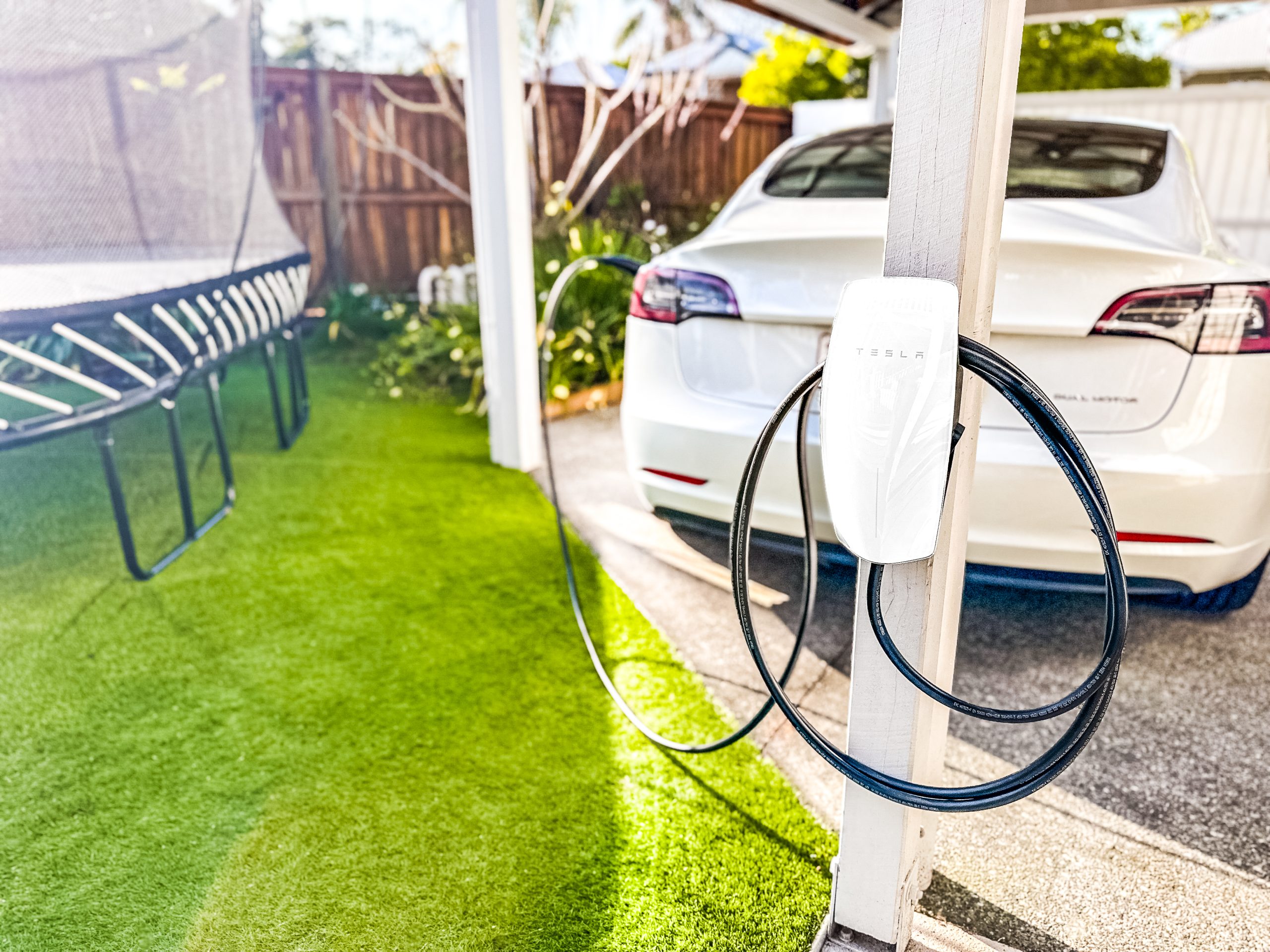
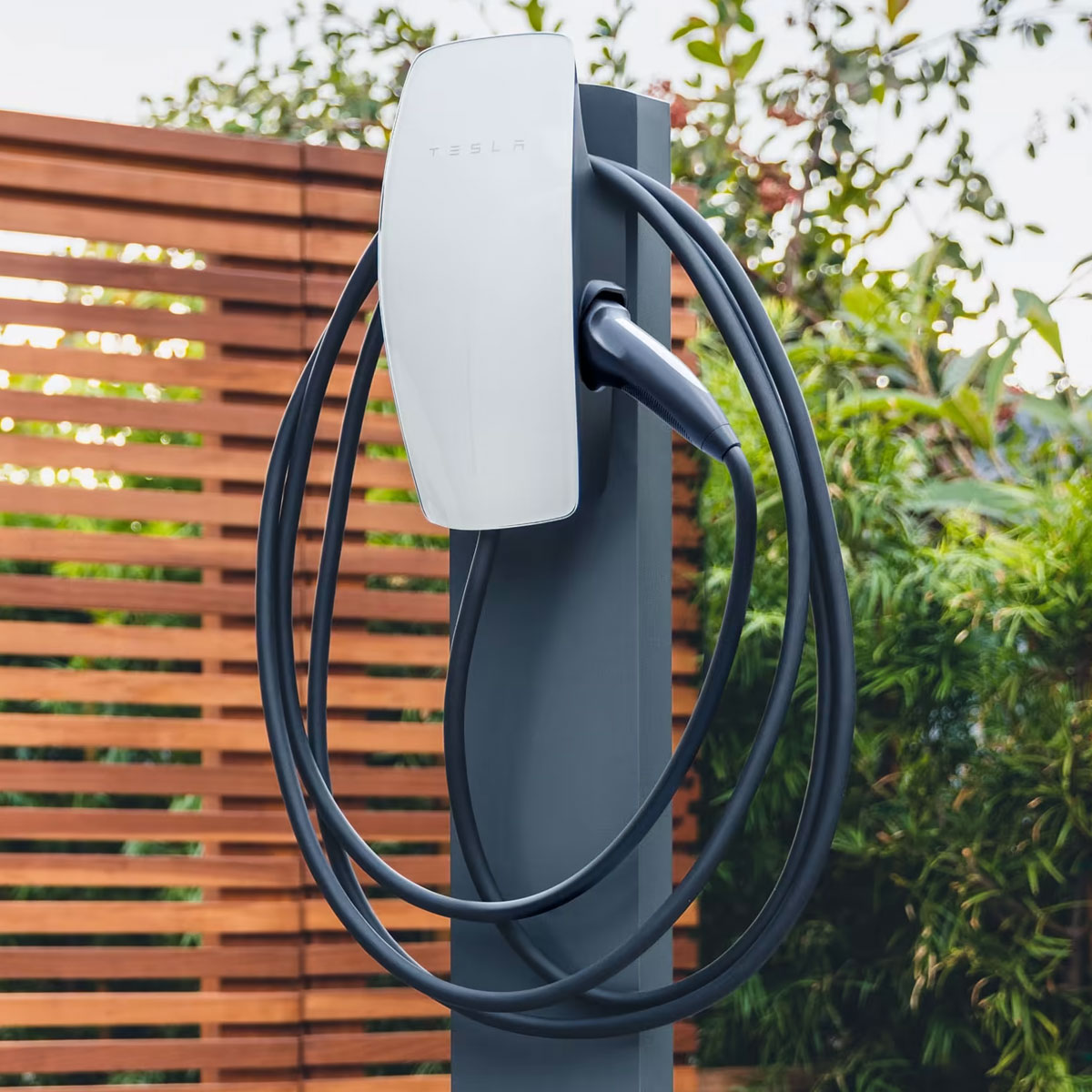
Tesla’s home charger, known as the ‘Tesla Wall Connector’, is the most elegant of all EV chargers. Surprisingly, it’s also our most affordable charger. It boasts a slimline, sleek design and a tethered cable that wraps neatly around the unit.
A Tesla home charger can charge any EV available in Australia. If you drive a Tesla, there are added benefits. The plug top on the Tesla EV charger has a button that opens the charger cover on any Tesla EV. It sounds like a minor feature — until you use a charger that doesn’t have it.
The Tesla Wall Connector allows surplus solar charging when connected into a full Tesla eco-system. So if you have a Tesla Powerwall and a Tesla EV, the Tesla Wall Connector is a “no-brainer”.

The Fronius EV charger, also known as the Fronius Wattpilot Flex, has its unique strengths. It’s the preferred choice for those with a Fronius Solar inverter. When linked to ‘Fronius Solar.Web’, the Fronius Wattpilot Flex functions efficiently as a Solar EV charger, updating data in less than 30-second intervals. Integrated into the Fronius ecosystem, your EV charging data blends seamlessly with your data on Solar.Web. The Fronius brand assures longevity.
It is a 7.4kW / 22kW charger depending on whether it’s connected to a single-phase or three-phase electricity supply. Unlike the Wattpilot Go, it is a tethered charger with a 6m fixed cable.
Interestingly, the Wattpilot Flex has been equipped with ISO15118 communication hardware as a way to hopefully support future V2H (Vehicle to Home) and V2G (Vehicle to Grid) functionality. This is subject to EV manufacturers getting their on-board inverters certified for bi-directional grid connection in Australia in accordance with relevant Standards and network regulations.
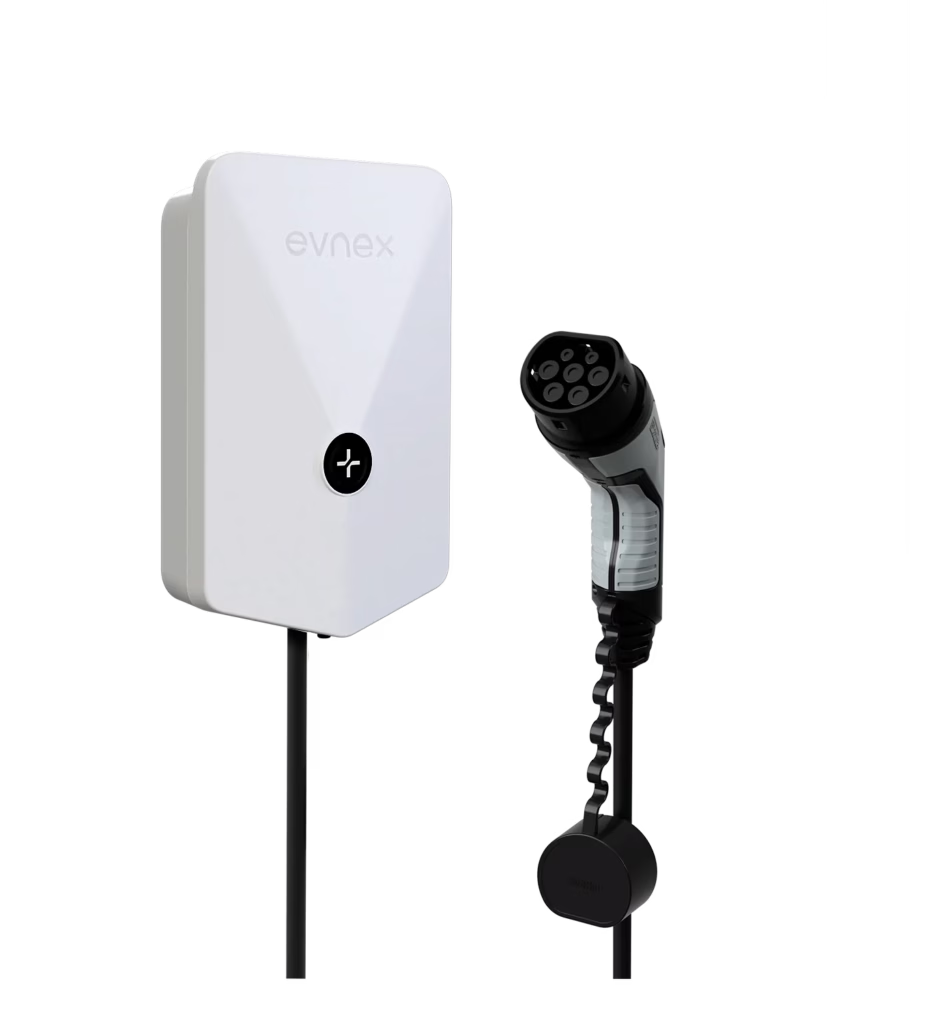
The Evnex EV does what Tesla and Fronius can’t – independent solar surplus charging via a dedicated, hardwired CT constantly measuring your site export. Unlike the Fronius Charger, you don’t need an active internet connection and a separate Fronius smart meter. Additionally, unlike Tesla, you don’t need a Tesla Powerwall and a Tesla EV in order to charge a car on sunshine alone. Even better, the Evnex charger comes with a 4G connection (like your phone), so you don’t need to rely on WiFi.
But how does it go when I pressure test it? Does it derate on hot days like the Zappi charger? Check out my video.
Sometimes we get it wrong. Zappi was one of those times. While Zappi was first to market, packed with features, and is one of Australia’s most popular EV chargers, it didn’t pass our testing. Here’s Mark’s honest review.
Charging an EV with solar is similar to charging a solar battery. First, we need to install a device to measure the excess solar energy being sent back to the grid. The more accurately this is measured, the more precise your solar EV charging will be. Zappi, Fronius, and Tesla each have different methods to measure excess solar.
Zappi makes real-time adjustments, and Fronius Wattpilot connects online, updating every half-minute. Tesla (the car, not the charger) can be connected to the third-party app Charge HQ, providing the most affordable yet less precise method.
Yes. A Tesla EV charger can charge any EV sold in Australia today. However, at present, Tesla chargers can only use excess solar when charging a Tesla car.
Level 2 three-phase chargers can generally charge at a rate of 22kW. Nonetheless, many EVs can only accept charge rates of 11kW (e.g., Tesla Model 3) or even 7kW (e.g., BYD Atto 3). As electric vehicles become more prevalent, they are anticipated to accept faster-charging rates exceeding 11kW.
The Tesla Wall Connector, and Fronius Wattpilot rank among the top chargers in the market. Each has its unique advantages and disadvantages. Watch Mark’s review below for a comparative analysis.
While the Tesla Wall Connector and Fronius Wattpilot are commonly referred to as EV chargers, they don’t actually perform the charging function. The actual charger is integrated into your Electric Vehicle. What we call an EV Charger is technically known as “Electric Vehicle Supply Equipment” or EVSE. However, to keep it simple, we’ll continue to call them EV chargers.